
Building With MERN for the Long Term, Not the Next Release
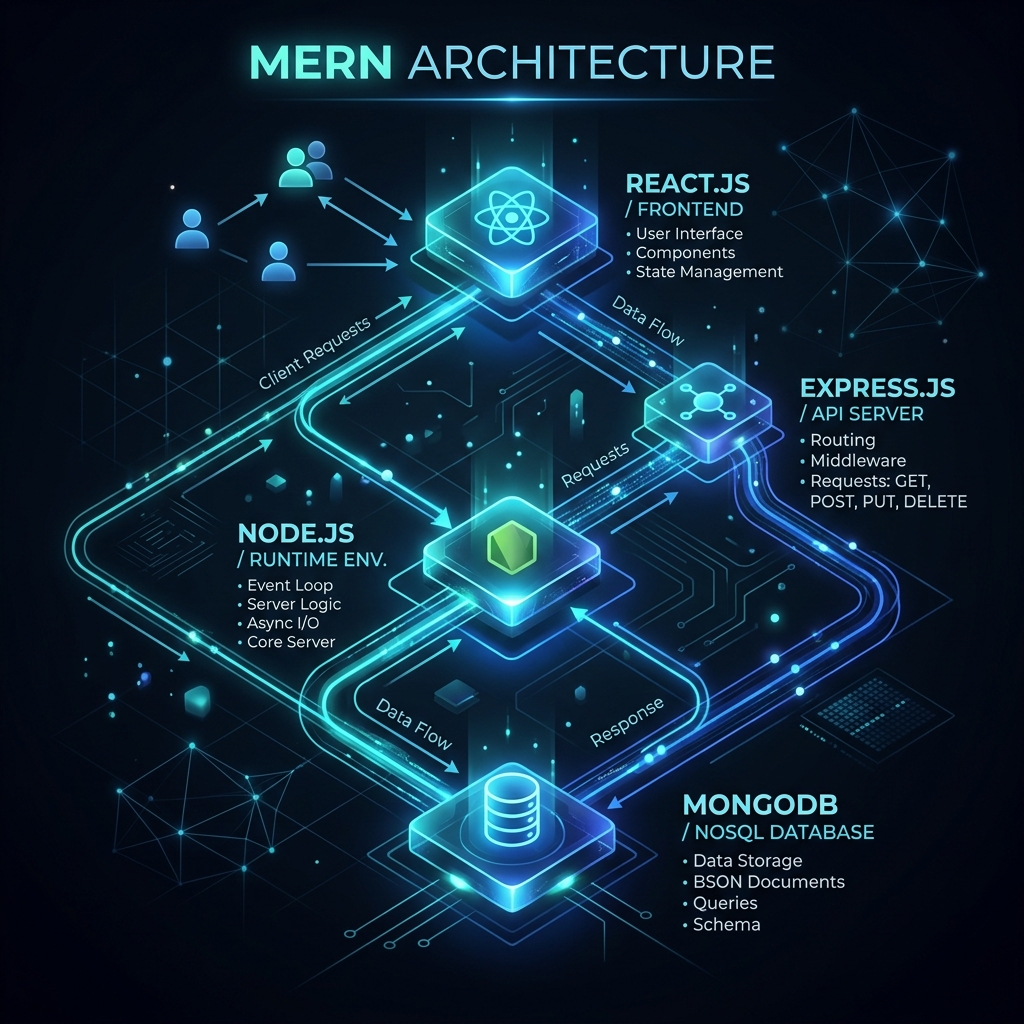
How to structure MERN applications so they remain reliable, evolvable, and easy to onboard to over years—not just sprints.
MERN remains one of the most pragmatic stacks for product teams that need to move quickly without losing control of complexity. However, the ease of starting a MERN project often masks the difficulty of maintaining one. Without a rigorous architectural foundation, a MongoDB-Express-React-Node ecosystem can quickly dissolve into a tangled web of interdependent modules.
In this article, we unpack how we design modules, APIs, and data boundaries so SaaS and platform teams can keep shipping confidently years after the first release. The core of our approach lies in Domain-Driven Design (DDD) applied at a level that doesn't over-engineer the system but provides clear boundaries for data ownership.
We start by examining the API layer. Many teams fail by letting their database models leak directly into their frontend components. At Devsort, we implement an abstraction layer using DTOs (Data Transfer Objects) and clear documentation using OpenAPI/Swagger. This ensures that a change in the database schema doesn't immediately crash the client applications.
State management is another critical node. While Redux was the industry standard for years, we now lean towards more granular solutions like React Query and Zustand. This reduces the boilerplate and allows for more efficient caching strategies, as we move away from a 'single source of truth' for all client state and instead focus on managing server state vs. UI state independently.
The middleware layer in Express is often where business logic goes to die. We advocate for a 'Service Layer' pattern, where Express controllers are thin and merely handle HTTP request/response logic, while the actual 'thinking'—the business logic—resides in dedicated service modules. This makes the system far easier to unit test and reason about.
On the database side, MongoDB's flexibility is a double-edged sword. We implement strict schema validation using Mongoose and ensure that indexing strategies are reviewed every quarter. We also look at when to separate frequently accessed data from archival data to maintain sub-second query performance as the collection grows into the millions.
Authentication and authorization are often handled as afterthoughts. We implement Zero-Trust principles from day one, utilizing robust JWT rotation and multi-tenant isolation at the database level. Each request is validated against a clear permission matrix, ensuring that scale doesn't introduce security regressions.
Observability is the final pillar. A long-term system must be visible. We integrate Winston or Pino for structured logging and connect every microservice to an ELK stack or New Relic. This allows us to trace a single user action through the entire stack, identifying bottlenecks before they impact the broader user base.
Finally, we discuss the 'Developer Experience' (DX). A system that is hard to work on is a system that will fail. We maintain high coverage in integration tests and provide clear, automated onboarding scripts. This ensures that new engineers can go from 'git clone' to their first PR within 24 hours.
By focusing on these long-term pillars rather than just the next release cycle, we build MERN applications that don't just survive growth—they thrive on it.